The previous post drew the four stages of torch.compile; the first is Dynamo, "capture". We said it intercepts your bytecode "as Python runs". That sounds light, but it hides a concrete question: how does a third-party package get to insert itself into CPython's execution and take over before your function runs?
The answer is not a monkey patch, and not source rewriting. It is a hole CPython left on purpose: PEP 523, the frame evaluation API. This post makes that hole clear.
First, how CPython normally runs a function
Every function call in Python makes CPython build a frame. The frame holds all the state of that call: local variables, the value stack, which bytecode instruction is next. The logic of a function does not run as source; it is first compiled into bytecode, stored on a code object.
dis lays the bytecode out:
import dis

def f(x):
    return torch.sin(x) + 1

dis.dis(f)
You will see something like:
LOAD_GLOBAL              torch
LOAD_METHOD              sin
LOAD_FAST                x
CALL_METHOD              1
LOAD_CONST               1
BINARY_ADD
RETURN_VALUE
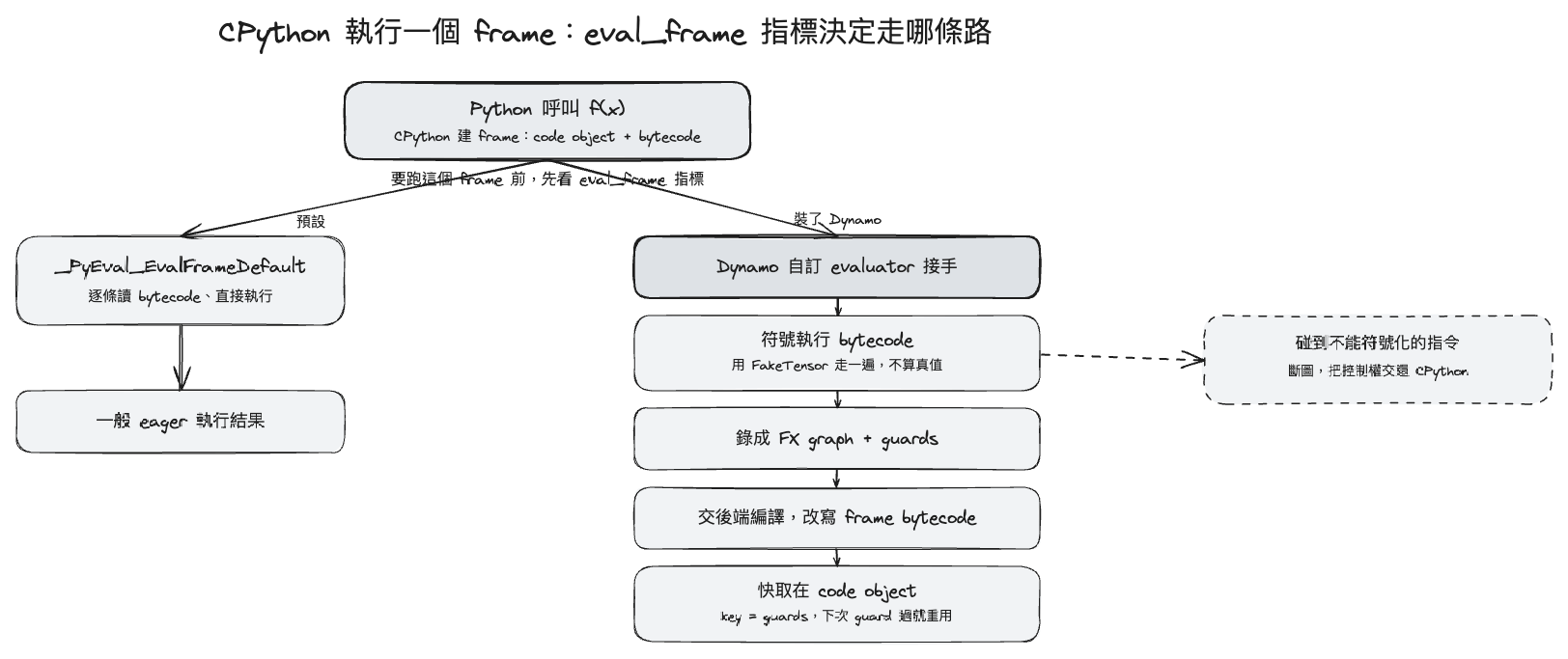
Normally, once CPython has a frame, it hands it to a C function, _PyEval_EvalFrameDefault. That is the big switch loop: read one bytecode at a time, execute it, update the stack. It is the heart of Python.
PEP 523: making "how to run a frame" replaceable
PEP 523 (introduced in Python 3.6) does exactly one thing: it adds a function pointer, eval_frame, to the interpreter state. When CPython is about to run a frame, it no longer hardcodes a call to _PyEval_EvalFrameDefault; it calls whatever this pointer points at. By default it points at the default, so behavior is unchanged.
But it means a C extension can swap that pointer for its own function. From that moment, before every frame runs, CPython first asks your custom evaluator: "this frame, how do you want to run it?"
That is Dynamo's foothold. It does not touch your source and does not wrap your function object; it sits one layer below the function, catching CPython's request to execute each frame.
What Dynamo does once it takes over
The first time you call f after torch.compile(f), f's frame reaches Dynamo's custom evaluator, and it roughly does this:
- Grab the frame's code object and bytecode.
- Symbolically execute the bytecode: instead of computing real numbers, it walks each instruction with symbolic values like
FakeTensor, recording "asinhere, anaddthere" into an FX graph. - Record the premises under which this holds, the guards (the subject of the next post), for example that
xhas a certain dtype and shape. - Hand the graph to the backend to compile, then rewrite this frame's bytecode: replace that stretch of computation with "call the compiled artifact".
- Cache the result on the code object, keyed by the guards. Next time the same function comes through, if the guards pass it uses the cache directly, no need to rerun Dynamo.
So Dynamo's "just in time" is not that it runs alongside watching; it stands directly on the path CPython must take to execute every frame.
Why bytecode, not source or AST
A natural question: to analyze a program, why not read the source, or parse the AST, instead of picking the lowest, hardest-to-read bytecode?
Because bytecode is the only form guaranteed to exist. Source may not be available at all (C extensions, code built with exec, lambdas, things behind decorators), and neither may the AST. But as long as a function can be executed by CPython, it has a code object and it has bytecode. Working at the frame layer, Dynamo can swallow Python from almost any origin, no matter who wrote it or how it was produced.
The cost is that it must implement its own symbolic interpreter for bytecode, re-specifying the semantics of hundreds of CPython instructions. This is the heaviest part of Dynamo.
Why "almost any" still keeps the "almost"
The frame eval hook lets Dynamo see every bytecode, but seeing it is not the same as being able to model it. Some instructions it cannot walk with symbolic values, the most typical being control flow that depends on an actual value:
def f(x):
    if x.sum() > 0:      # you must really compute x.sum() to know which branch
        return x * 2
    return x + 1
x.sum() > 0 is a value that has to become a concrete Python bool, but Dynamo holds a symbolic tensor and does not know which branch to take. It does not guess; it breaks the graph: it collects what it captured before the if into one graph, hands control back to CPython to run the if, and once the branch is settled, resumes capturing the next graph after it. That is the graph break from the previous post; Day 14 is devoted to it.
The same forced break also comes from: calls into C functions it has no symbolic model for, .item()-style operations that pull a tensor value out into a Python scalar, and side-effecting things like print. The frame eval hook gives Dynamo the ability to "see everything", but "everything can be symbolized" is a different matter, and that boundary is the spine of the rest of Part 1.
See it rewrite the bytecode yourself
Dynamo's rewritten bytecode is not a black box; TORCH_LOGS dumps it:
TORCH_LOGS="bytecode" python your_script.pyYou will see two chunks of bytecode: the original, and Dynamo's rewritten version. The rewritten one contains a call into the compiled artifact, replacing that run of LOAD_METHOD / CALL_METHOD. This is the most direct way to confirm "Dynamo really acts at the bytecode layer", and it echoes the method from the previous post: read each stage with your own eyes before moving on.
Next post
This post settled "how Dynamo takes over". But "symbolically execute the bytecode" went by too fast: Dynamo holds no real values, so how does it walk LOAD_FAST, CALL_METHOD, BINARY_ADD one by one while maintaining a stack identical to CPython's? The next post (Day 13) opens the body of that symbolic interpreter: InstructionTranslator. We will read along with torch/_dynamo/symbolic_convert.py and see how it rewrites CPython's stack machine at the Python level, one handler per instruction, the graph growing as it walks.